Thursday, May 6, 2010

Traveling Safely in your Car

Travel season is upon use, many families will be hitting the roads for vacation when the kids get out of school for the summer. We sometimes take travel too lightly, we forget the dangers involved. Be safe, travel safe and you'll have more fun when you arrive at your destination. Practice car safety, you life may depend on it.

But before you go review this list, make sure you and your car are ready for a safe journey.
  • Have you checked your tire pressure?
  • Do you a full tank of gas?
  • Have you filled up the window washer fluid? Sometimes its' a good idea to have extra in the trunk
  • Do you a window scrapper (depending on when and where you're going, like the mountains even in summer you may need it)
  • Do you have a flash light for emergencies?
  • Do you have a cell phone charger that works in your car?
  • Does someone have your license plate number and the route you plan to travel?
  • Do take frequent breaks to stretch your legs and give your eyes a rest, change drivers if you're not alone.
  • Do you have a map along with written directions/GPS in case you run into road blocks, construction or changes that sometimes happen?
  • If you're alone, don't travel late at night.
  • Take your purse and cell phone with you when you stop to go to the bathroom, you may need them should an emergency arise.
  • Lock the car at all times, when you're in it and when you're not.
  • Do you have an extra car key in your pocket/purse? Or does the person you're with have an extra key?
  • Don't run on fumes because you don't want to stop for gas, fill up when you still have at least 1/4 of a tank. You never know when you may get in bad traffic, or exists are closed or you run into construction. Any number of things can happen. The gas may not be readily available in certain areas.
  • Many states have laws prohibiting the use of cells phones while driving without it being hands free. I love my blue -tooth for travel. You're connected if you have to make a fast emergency call, but you don't have to take your eyes off the road to make it happen. With that being said, limit your calls to necessary calls. I know I've been behind people for miles and miles who are chatting totally unaware they're changing speeds, crossing the line, and in general paying more attention to the call then the importance of driving.
  • Buckle up ALL THE TIME!
  • Don't drive barefooted. How many of you have seen someone with a foot out the window? I have, even the driver on a few occasions. That's not safe, it's just plain stupid.
  • Don't have music on so loud you can hear a siren or emergency vehicle
  • Be aware of your surroundings. Look where you are, notice who's around you. Don't walk to the restroom with your head down texting or changing your music with your earphones in. People unaware are an easy mark.
  • Don't leave valuables visible in the car, like your mp3 player, your video games, your cell phone, your purse, your GPS, your IPod, or laptop. Those are call out to would be thieves who are watching and waiting for their opportunity.
Now enjoy yourself, and happy traveling.

Add to Technorati Favorites
Bookmark and Share

Monday, May 3, 2010

Fish Hall Plantation, Barkers Field, Hilton Head, South Carolina

Barker FieldOdd you might think to see an historic marker along side a small community baseball diamond. Must admit as we pulled the car off the road, so did I. I wondered what the story behind Barkers Field was.
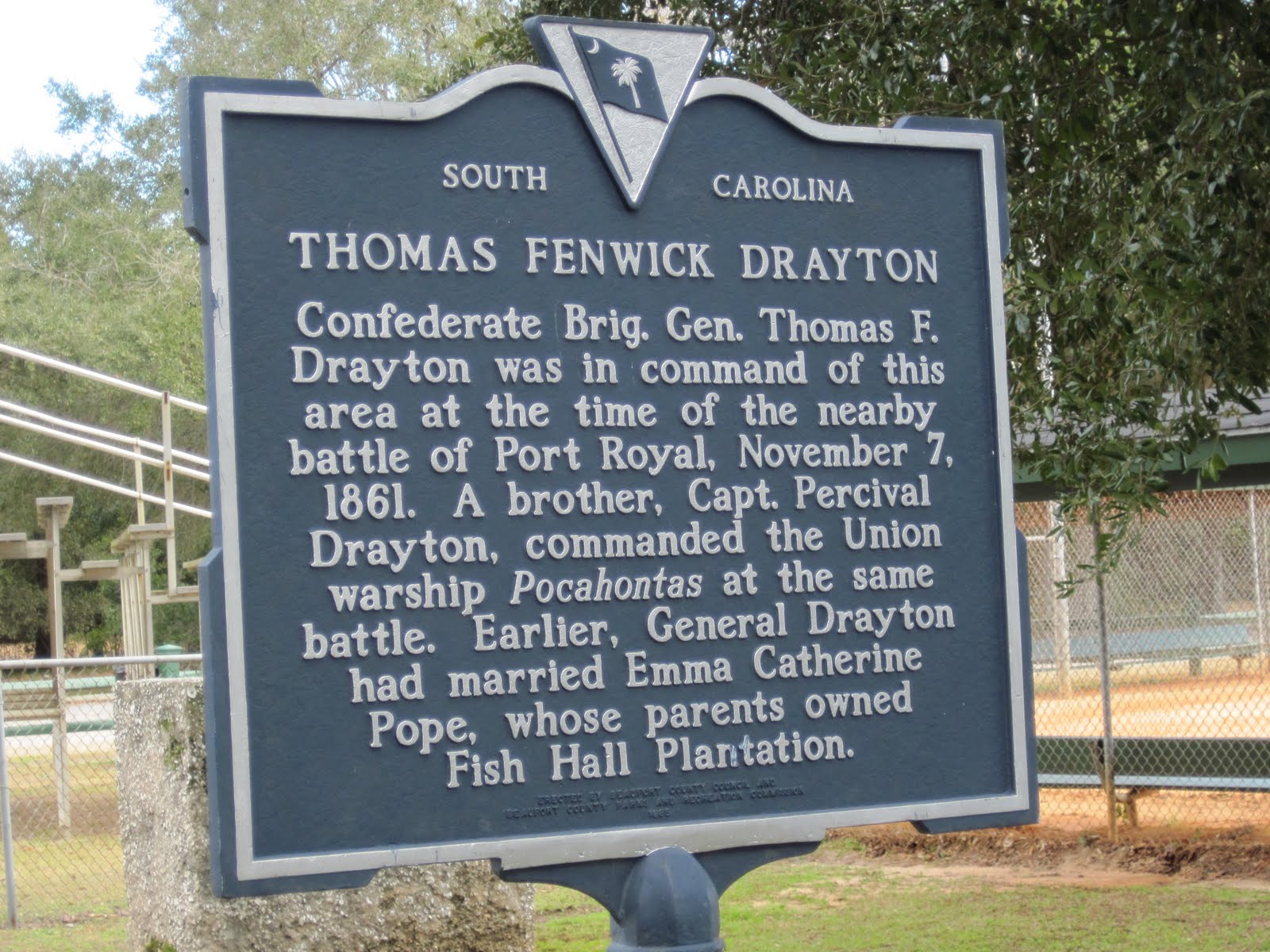
Thomas Fenwick Drayton historical markerA close up of the sign indicates a Confederate Brigadier General named Thomas Fenwick Drayton fought the Battle of Port Royal in this area. The Battle of Port Royal was a decisive battle during The Civil War. 18 Union Warships bombarded the Confederates at Fort Walker. Under the leadership of General Thomas Sherman 13,000 Union soldiers landed on the beach and established an important blockade. This battle was one of the earliest amphibious operations of the war. General Drayton's brother Captain Percival Drayton remained loyal to The United States and fought on the side of the Union forces. He commanded one of those war ships, The Pocahontas. Brother against brother, families pitted against each other made this war so very personal. I can't imagine the heartache within a family; but know throughout history there are many examples of this.
Fish Hall Plantation Historical MarkerSlightly to the right of the ball diamond along side the road is this fenced area with the above sign. This area had been a large 500 acre Plantation. The land originally given to Col. John Barnwell after The Revolutionary War. Historical research indicates early census's show's cotton was probably the primary crop grown here, as very little livestock appeared on the census. A description of the primary house said it was lordly. I've not seen a picture of it, but one count indicates early pictures of the main house agreed with the description. This was a prosperous plantation which owned 52 slaves according to the 1860 census. Thomas Fenwick Drayton married Emma Catherine Pope, the daughter of the plantations owner. Another account reported General Drayton owned 102 slaves. Perhaps he added his slaves to those already on the plantation after he and Emma married? Perhaps, as often happens there are a few discrepancies in the actual numbers.
Tabby Ruins of slaves quartersThis is one of two structures I saw, showing very little left of this once grand plantation. This is the tabby remains of a slaves' cabin, believed to be a fireplace. There's a 2nd one a short distance from this, perhaps 30 feet or so. Given what was learned from other tabby ruins, (Baynard Ruins) I assume it to be a 2nd fireplace. Seems common that 2 slave families were forced to share these cramped quarters.

In some of my research it seemed there is evidence of a building, or parts there off from this plantation still in existence; but as it's behind a gated community here on the Island it's not accessible to the general public. I found this most irritating. There were several items I found, that I believe have markers and structures to see; but the public is not permitted to see them unless on a school tour or a paid scheduled tour. In some cases it seemed the tours are only once in a blue moon; not really a company or on going; but an individual that would schedule it. Hilton Head has the reputation of being snooty, a playground for the rich and famous. While much has been protected environmentally, I personally was put off that only those living behind these gated communities or only those playing golf there for the day had access. (We attempted to see what was left of Fort Walker and were turned away at the gate of one such gated community).

The sign indicates graves were moved from this area to Drayton Cemetery. Apparently at some point the family didn't want slaves graves near their home so set aside land for a cemetery. I read one report that said this wasn't very successful, another indicated the graves were in fact moved. However, I've not yet been able to determine who is buried there. That is to say, are there unmarked burials, or are there headstones in this cemetery? Is there even a sign indicating it's a cemetery? (I've seen a few cases where if you didn't know, you really wouldn't know by looking). I've not found evidence of the burials beyond the statement graves were moved there. If I ever get back to Hilton Head, I'd like to follow up and actually find the cemetery. The Union forces established a Freeman's Village here, the only one known to have been established by The Union forces. When The Union forces came ashore that November day in 1861, many of the slaves joined forces.
Add to Technorati Favorites
Bookmark and Share